
The sub station at 345 Lee High Road
The first fire station in Lee Green opened in 1875 at 345 Lee High Road. Housed in a converted shop building, it served the local area as a sub station.
A new fire station
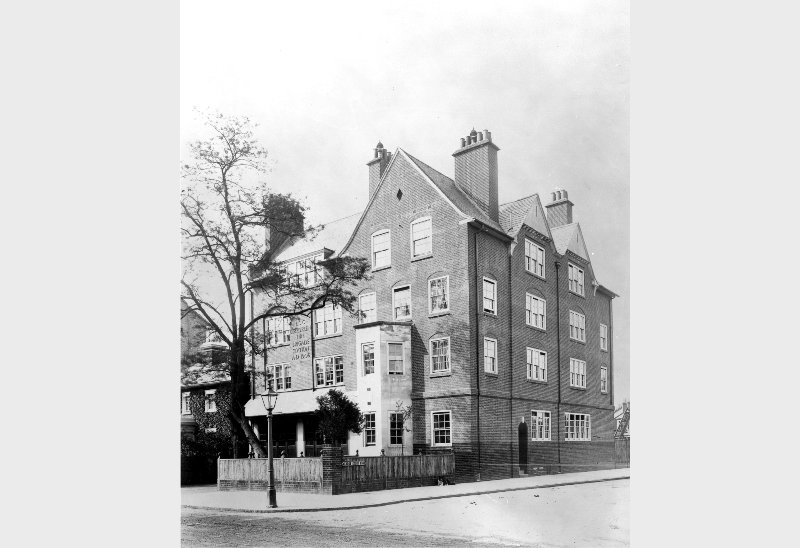
Lee Green Fire Station, taken in around 1910
As firefighting demands increased, a new purpose-built fire station was commissioned in 1905. Designed by architects Owen Fleming and Charles Canning Winmill, the building was created specifically to meet the needs of a modern fire brigade.
The station officially opened on 13 December 1906. The opening ceremony was led by Lewen Sharpe, Chair of the London County Council Fire Brigade Committee.
The building includes several distinctive architectural features, most notably the large stone bay window that extends from the ground floor to the first floor.
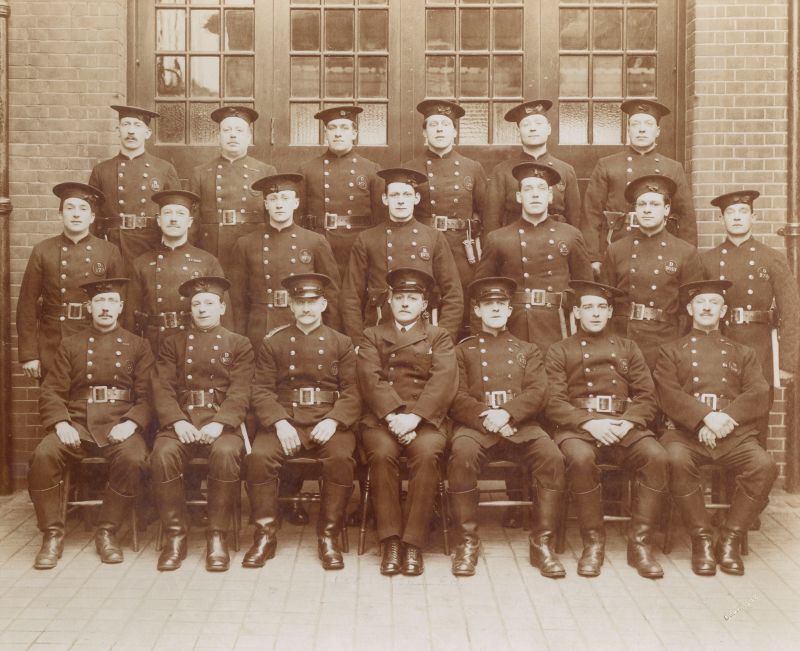
Firefighters stationed at Lee Green, taken in the early 1900s
The ground floor contained the appliance room, watch room, reading room and recreation room. Living accommodation was provided on the upper floors for the station officer and firefighters. Three cottages at the rear of the site offered additional homes for firefighters and their families.
A motorised fleet
Lee Green was one of the earliest London fire stations designed to operate entirely with self-propelled fire engines. It was the second station in London to do so, following the opening of Wapping Fire Station in 1905.
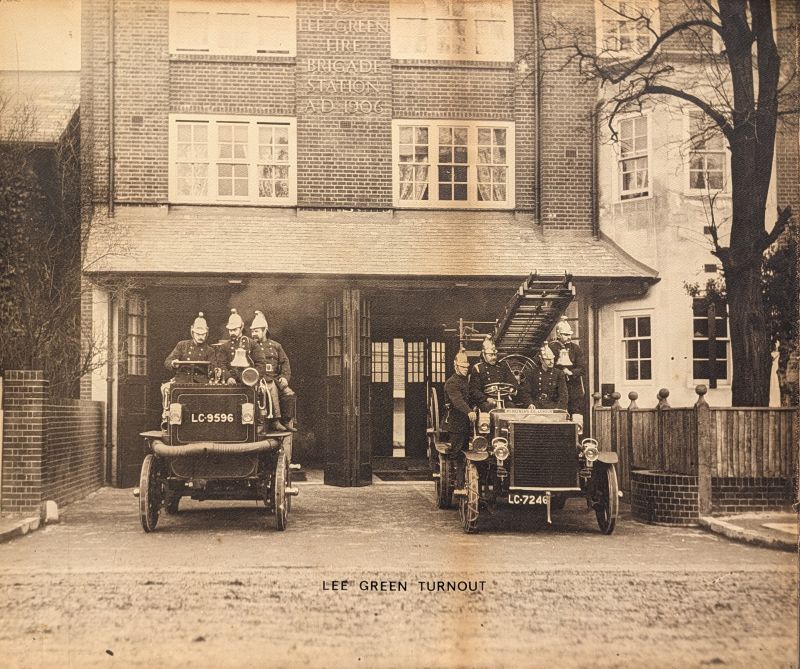
A turnout at Lee green Fire Station, featuring (left) a Merryweather Fire King fire engine and (right) a Merryweather Hatfield pump fire engine, taken between 1906-1908
Contemporary newspaper reports recorded that the station's fleet included a Merryweather Fire King steam-powered fire engine (LC 9596), a Merryweather Hatfield petrol motor pump fire engine (LC 7246), and a small Wolseley first-aid tender built in Birmingham.
The station's opening ceremony included a demonstration of the new appliances. Miss Hughes, daughter of W. B. Hughes of the Lewisham Board of Guardians, activated a practice alarm. Newspaper reports noted that the appliances left the station within 19 seconds, which was described as "a smart performance".
By 1908, Lee Green's fleet was fully motorised, marking an important step in the modernisation of firefighting in London.
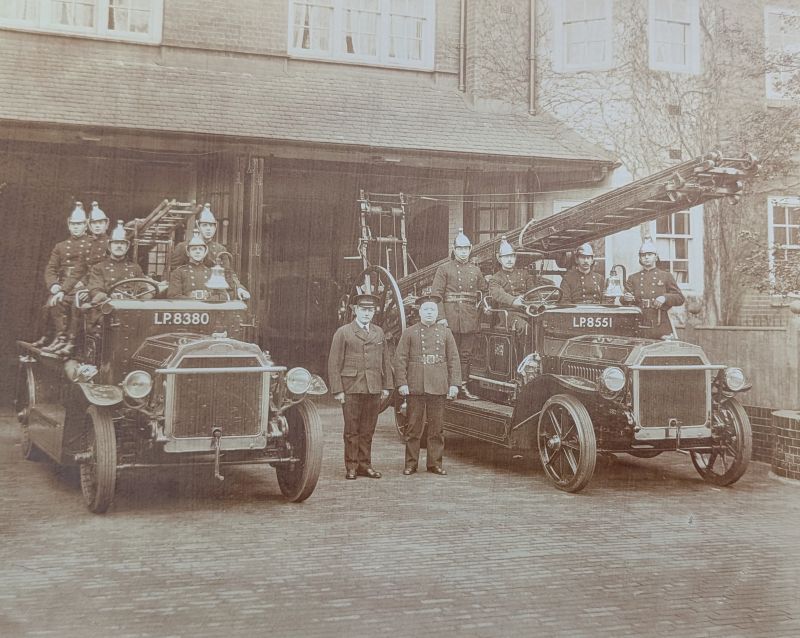
Firefighters outside of Lee Green Fire Station Lee Green Fire Station with a Dennis Motor Escape Van (LP 8551) and Dennis pump fire engine (LP 8380), taken in 1930
The Second World War
The Auxiliary Fire Service (AFS) was established in 1938 as part of Britain's Civil Defence preparations. The organisation greatly expanded firefighting resources during the Second World War.
During the war, Lee Green Fire Station was supported by five temporary fire stations based in local schools:
- Sandhurst Road School
- Pendragon Road School
- Barking Road School
- Briset Road School
- Manor Lane School
In 1941, fire brigades across the United Kingdom were merged to form the National Fire Service (NFS), helping to coordinate firefighting during wartime. The NFS remained in operation until 1948, when local fire brigades were re-established.
After the war

Hose-laying lorry stationed at Lee Green Fire Station in the 1950s
During the 1950s, crews at Lee Green used a specialised hose-laying lorry when incidents were located too far from a hydrant or other water source.
Starting at the nearest available water supply, the vehicle laid hose as it travelled towards the fire. Up to a mile of hose could be deployed during a single journey.
Once at the incident, the hose connected to a fire engine, providing a continuous supply of water for firefighting operations.
The station was granted Grade II listed status in 1973, recognising its special architectural and historic interest.
Historic England describes Lee Green Fire Station as:
"of special architectural interest as one of a remarkable series of fire stations built by the London County Council between 1896 and 1914, each executed to a bespoke design".
The station today

More than a century after it opened, Lee Green Fire Station continues to serve the local community. Crews respond to a wide range of emergencies, including fires, flooding and road traffic collisions.
Today, the station is home to a Pump Ladder fire engine and an Operational Support Unit.
Why is this fire station significant?
Lee Green Fire Station represents an important period of change in London's firefighting history. As one of the capital's earliest purpose-built motorised fire stations, it marked the transition from horse-drawn equipment to modern fire appliances.
The station is also a notable example of the London County Council's fire station building programme of the early twentieth century. Its distinctive architecture, surviving historic features and continued operational use make it an important part of London's firefighting heritage.