The Fire and Rescue National Framework for England requires fire and rescue authorities to publish a yearly Statement of Assurance. For London, this report explains how the London Fire Commissioner has followed the National Framework and the Community Risk Management Plan, and it provides assurance to the public and government about how the service operates.
Together with the Brigade’s Annual Governance Statement and Statement of Accounts, the below report fulfils this requirement for 2024/25. This report focuses mainly on operational assurance and highlights key activities across the organisation.
Contents
- Foreword by the London Fire Commissioner
- Introduction
- Legislative Framework
- Community Risk Management Plan
- Performance
- Community Engagement
- Prevention
- Protection
- National Resilience
- Marauding Terrorist Attacks (MTA)
- Mutual Aid and Collaboration
- Operational Competency
- Health, Safety and Wellbeing
- Fire Standards
- Governance Assurance
- Financial Assurance
- Inspection, Intervention and Accountability
- Assurance Declaration
Foreword by the London Fire Commissioner
1. This was our second year of delivering ‘Your London Fire Brigade’, our Community Risk Management Plan (CRMP) for 2023-29. The CRMP is underpinned by a seven-year delivery plan. Localised services are shaped through Department Plans, Borough Risk Management Plans and Station Delivery Plans, supporting our response to the changing needs of London’s communities. We have aligned the Brigade’s resources to CRMP priorities, and the Brigade’s activities and major initiatives this year were all rooted in the CRMP. This included addressing recommendations arising from Phase 2 of the Grenfell Tower Inquiry (GTI).
2. The Grenfell Tower Inquiry Phase 2 Report was published in September 2024 and contained 58 important recommendations. The final report of the Inquiry is another significant milestone in learning the lessons from the tragic fire. We worked in collaboration with stakeholders and relevant communities to develop a response to each of the Phase 2 recommendations relating to the Brigade, and we published this in October 2024. It sets out the changes we have made since the fire, as well as our plans for further changes. We are not complacent; change is at the heart of how the Brigade operates today, and we will remain a listening, learning, and leading organisation. We are in dialogue with the Government and Mayor of London as we all look at what must be done to ensure buildings in London are safe. We will continue to collaborate with them, advocating for improved standards in the built environment to ensure greater safety. Our thoughts remain with the 72 people who lost their lives, as well as the survivors, the bereaved families, and the Grenfell communities. We owe it to them and our staff to continue learning from this tragedy.
3. Another hallmark of the past year was London Fire Brigade’s third full inspection by His Majesty’s Inspectorate of Constabulary and Fire and Rescue Services (HMICFRS), which took place in summer 2024, and HMICFRS published its report in November 2024. The report demonstrated a clear assessment of positive change across nearly all areas of the Brigade, and improvements in 10 out of 11 areas in inspection. A meaningful change has taken place since the previous inspection, underpinned by millions of pounds of investment provided by the Mayor of London. This has resulted in Firefighters and Control officers being better prepared, trained and equipped to deal with fires across London. The Inspectorate acknowledged the strides taken to improve the service LFB provides to London, as well as changed ways of working and ongoing work to transform culture across the organisation. This has included our improved understanding of risk and other emergencies through our CRMP. However, there is no room for complacency, and we will seek to build on this positive outcome. This includes prioritising the risk-based inspection programme, recruiting a more diverse workforce, continuing to build confidence in processes for dealing with poor behaviour, and creating a process for identifying talent and future leaders within the Brigade.
4. LFB responded to several significant and high-profile incidents during the past year. In August 2024, 225 firefighters responded to a major fire at Spectrum House on Freshwater Road in Dagenham. Crews and officers worked in the most dangerous conditions to rescue people and bring the incident under control, despite being faced with a significant building failure. A full simultaneous evacuation of the building was immediately carried out and a significant search and rescue operation took place. More than 80 people were evacuated, with firefighters leading people to safety and carrying out 20 rescues, including four using fire escape hoods. The Brigade’s Control officers gave out vital fire survival guidance using our App, which allows information to be exchanged between Control and the incident ground in a timely, accurate and consistent manner. We also used new equipment such as drones, and our 32-metre and 64-metre turntable ladders to provide Incident Commanders with a vantage point for assessing the scene as well as to deliver water onto the fire from above. We declared a major incident, stood up full strategic arrangements, and stationed members of our dedicated community engagement team at the rest centre to support residents alongside partners. The Brigade’s response to the fire is evidence of the institutional change across the Brigade since the tragic Grenfell Tower fire.
5. To allow greater investment in prevention activity, in October 2024 we stopped attending automatic fire alarms (AFAs) in most commercial buildings during the day, unless we receive a call reporting a fire. In 2023/24, AFAs made up 40% all incidents that the Brigade attended – 52,000 calls. Less than one per cent of calls from non-residential AFAs are ultimately recorded as fires. Reducing the amount of time and resources spent on responding to false alarms means LFB can focus on priorities, including fire safety in communities.
6. We committed to acting on emerging risks such as those posed by lithium-ion batteries, which are London’s fastest-growing fire risk. Fires involving e-bikes rose from 13 in 2020 to 142 in 2024, and data segmentation shows that these fires disproportionately affect disadvantaged Londoners. We launched the third phase of the #ChargeSafe campaign this year, extending our local events and expanding by working with regulators and partnering with businesses. Polling in March 2025 showed that 67% of Londoners said they feel knowledgeable about the risks associated with e-bikes and e-scooters, compared with 43% when we launched the campaign in April 2023. As part of our campaign, we have been warning about the lack of regulation for products sold via online marketplaces, and in July we welcomed the introduction of the Product Regulation and Metrology Bill. The King’s Speech introducing the legislation cited information shared by LFB, and the Brigade has also responded to the Government’s call for evidence. The Bill is currently going through Parliament, and we hope that the legislation will protect consumers from the risks posed by unsafe products.
7. This year, LFB has also taken further steps towards reducing and managing the risk of wildfires in London – as the Brigade continues to act on the learning from the experience of the summer of 2022 in which there were record numbers of wildfires – through a combination of public awareness campaigns and investment in new vehicles and capability. The Brigade has continued to make significant investment into its training, operational response and equipment to help reduce, prepare for and respond to extreme weather events. Drawing on national best practice, we now train our Officers with the latest fire tactics for dealing with wildfires and fires occurring at the edges of urban conurbations. New firefighting equipment has been introduced which includes the ‘Holey Hose’ equipment and the continuing pilot of new 4x4 vehicles, partly funded by the Mayor of London.
8. Andy Roe, formerly London Fire Commissioner, announced that he would be retiring at the end of June 2025, 23 years after joining LFB. Over the past five years as London Fire Commissioner, supported by the Mayor of London, amid a backdrop of increased financial pressures which are impacting all public services, Andy led significant change and improvement across the organisation, including the way we respond to emergencies. There is still work to be done – and there always will be, but our people are now better trained and equipped for their mission to serve and protect London. As the new London Fire Commissioner, I will continue to lead LFB’s improvement journey.
Introduction
9. The Fire and Rescue National Framework for England sets out a requirement for fire and rescue authorities to provide an annual Statement of Assurance.
10. The Framework requires that the statement should outline the way in which the London Fire Commissioner (LFC) has had regard to this National Framework and the Community Risk Management Plan. It must also provide assurance to our community and to the government on financial, governance and operational matters.
11. This Statement, alongside the LFB Annual Governance Statement and LFB Statement of Accounts, satisfies that requirement for the 2024/25 financial year.
12. The Brigade produces separate annual governance and accounting statements which go into these areas in more detail. Consequently, this report focuses initially on operational assurance and provides overviews of our governance and financial oversight arrangements.
13. This Statement provides indications of key activities in key areas of the organisation.
Legislative Framework
14. The National Framework outlines the requirements for fire and rescue authorities to provide assurance on operational matters.
15. Fire and rescue authorities operate within a clearly defined statutory and policy framework. The key documents defining operational responsibilities for London Fire Commissioner (LFC) are the:
- Fire and Rescue Services Act 2004;
- Civil Contingencies Act 2004;
- Regulatory Reform (Fire Safety) Order 2005;
- Fire and Rescue Services (Emergencies) (England) Order 2007;
- Localism Act 2011;
- Policing and Crime Act 2017; and
- Fire and Rescue National Framework for England 2018
Community Risk Management Plan
Assessment of Risk
16. The Fire and Rescue National Framework for England 2018 places a duty on all Fire and Rescue Services to “identify and assess the full range of foreseeable fire and rescue related risks their areas face”.
17. The LFC’s Assessment of Risk (AoR) is our response to that requirement. It includes foreseeable risks to which the Brigade might be expected to respond and wider risks that may impact it in the longer term.
18. In our AoR, risk is assessed based on a combination of likelihood and consequence. The AoR includes the analysis of low likelihood, high consequence events through the inclusion of the London Risk Register and analysis of new and emerging risks. It is a layered document that assesses community concerns, local incident data, extraordinary risks, and future risks as independent layers.
19. If new potential risks are identified that require assessment, these will be considered as part of our corporate risk governance process. Risks which cannot be brought within the LFC’s risk appetite through existing work in progress or planned controls, will be escalated to the corporate risk register. The AoR provides a high-level overview which can be used to prioritise work and resources.
20. The AoR informed the development of our 2023 –2029 Community Risk Management Plan (CRMP) and is reviewed annually as a CRMP commitment, or as significant new data becomes available between annual reviews.
21. The AoR is published on our external website. Our AOR for 2024 can be found here.
CRMP
22. The national framework also requires us to publish an Integrated Risk Management Plan (IRMP) known as the CRMP. The CRMP serves as our primary organisational strategy – including both statutory obligations and our strategic ambition and requires the approval of the Mayor before it is published.
23. In January 2023, LFB published the latest CRMP, called ‘Your London Fire Brigade’. As well as including an assessment of all foreseeable fire and rescue related risks referenced above, the plan demonstrates how our six services (Prevention, Protection, Response, Prepare, Recover and Engage) are utilised to prevent fire, other incidents, and mitigate the impact of identified risks; in addition, reduce incidents on the community.
24. It articulates what Officers will do to achieve our ambition of being trusted to serve and protect London by 2029. It was developed using feedback from the public and LFB staff, from His Majesty’s Inspectorate of Constabulary and Fire and Rescue Services and from Phase One of the GTI. Our ambition for the six services is expressed through our service strategies, which also seek to address the risks as identified in the AoR.
25. The service strategies are delivered through our Borough Risk Management Plans, Department and Station Delivery Plans. Each of these plans details specific local targets, risks, priorities, and improvements. The eight commitments in our CRMP were being delivered through a combination of transformation programmes, departmental projects, continuous improvement and business as usual.
26. In Q4 2024/2025, the Brigade announced that the Transformation directorate would close in Q1 2025/2026, and that the Brigade would review its programmatic approach to delivering change beyond 2026.
Performance
CRMP Performance outcomes in 2024/2025
27. The Brigade achieved 21 of its CRMP Key Performance Indicator (KPI) targets in 2024/25 which is an improvement on 2023/24 when 17 targets were met. The four KPIs which LFB have newly achieved this year are: ratio of high-risk audits completed, station staff time spent on protection, percentage of staff trained to respond to marauding terrorist attacks and percentage of managers who have completed training against plan.
28. There were 10 KPIs where LFB did not achieve the target and of those three were >10% off-target. For staff composition (women, ethnic minority staff and staff with disabilities) LFB is within 10% of the target with a view to reviewing this target for 2026/27.
29. Percentage of high-risk home fire safety visits (HFSVs) and false alarms attended due to automatic fire alarms (AFAs) in non-domestic buildings were similarly close to target. There has been both a new approach to targeting risk with regard to HFSVs and a new AFA policy which have resulted in significantly improved performance this financial year and expect to meet both targets this financial year (2025/26).
30. The number of fire injuries and accidental fire deaths in the home have targets associated with them that LFB aims to achieve by the end of the CRMP lifecycle. As these are small volumes, averaged out over five years, improvement takes some time to materialise in the data.
31. The three KPIs where LFB were >10% away from achieving them are; number of triages via the online home fire safety checker, number of RIDDORs and staff sickness.
32. LFB strategy to increase uptake of the online home fire safety checker during 2025/26 is to increase the number of triages through multiple interrelated strands of activity. LFB will further optimise our website to drive up click-throughs from organic searches. LFB will continue to improve the accessibility of its website in a range of ways, including through providing safety advice in British Sign Language and creating new easy-read literature, which links through to the checker. The Brigade are supporting public-facing colleagues to promote the checker, where appropriate, during interactions with members of the community.
33. LFB has an ambitious target for RIDDORs, having reduced our target by 10% for three consecutive years. The Health, Safety and Wellbeing (HSW) Board has continued to provide greater corporate oversight, challenge, scrutiny and assurance of health and safety performance in support of the Service Delivery Board’s purpose and responsibilities. The HSW Board helps drive the health and safety agenda for the Brigade and ensure that health, safety and wellbeing-related workstreams are given sufficient priority. This includes monitoring of the Safety Culture Improvement action plan.
34. A working group, between the Fire Stations and the Health, Safety and Wellbeing departments, has also been introduced to specifically support effective delivery of initiatives to improve health and safety in operations and on fire stations.
35. Staff sickness has been a significant challenge since COVID, and our target reflects the pre-COVID average. The Brigade has undertaken many improvement initiatives, including the continuing Attendance Project for Fire Stations and establishing a Long-Term Absence Panel. This work is now starting to pay dividends as we have seen three consecutive positive outliers from March to May 2025, with April 2025 seeing the lowest total sickness in a single month since June 2021. This is particularly encouraging as this is during a period of time where seasonal sickness usually starts to increase.
Community Engagement
Grenfell Memory Project
36. As part of the Brigade’s ongoing commitment to building meaningful and effective relationships with the bereaved families, survivors, residents, and wider stakeholders affected by the Grenfell tragedy, a senior lead was appointed to the Community Engagement team during 2024/25. This dedicated role was established to oversee the development of the Grenfell Memory Project and to support sustained engagement with all strands of the Grenfell communities.
37. To ensure that the Grenfell Memory Project was inclusive, transparent, and reflective of the community’s diversity, LFB undertook a comprehensive stakeholder mapping exercise. This enabled the Brigade to identify and reach out to the wide range of individuals and groups connected to Grenfell, recognising their unique perspectives, needs, and concerns.
38. LFB has worked closely with representatives from 20 groups comprising bereaved families and survivors to shape both the consultation strategy and the funding framework for the Grenfell Memory Project. These insights have directly informed the development of a funding framework that acknowledges and respects the community’s diversity in faith, culture, heritage, social circumstances, and instances of family estrangement.
39. Engagement activities included group sessions, virtual and in-person one-to-one conversations, a questionnaire, and regular contact via email, phone and text. This multi-channel approach ensured broad and accessible participation. In line with LFB’s commitment to transparency and accountability, the Brigade has implemented robust systems to document, store, and act upon community feedback. It also provides regular updates to ensure that LFB remains responsive to the evolving needs and views of the Grenfell communities.
Community Forum
40. In 2024, the LFB Community Forum continued to play a vital role in shaping the Brigade’s services. Across the year, the group fed into projects and campaigns, reviewed new strategies and policies, and contributed to LFB’s response to the Grenfell Tower Inquiry Phase Two Report. The Forum met with senior leaders across the Brigade, and members have continued to develop as individuals and as a group. There was a group away day and training sessions, ensuring members are equipped with the necessary tools to properly scrutinise LFB.
41. The Community Forum held monthly meetings, as well as participating in several interview panels for senior staff, including the Assistant Commissioners and Deputy Assistant Commissioners, and the new London Fire Commissioner.
42. Topics that the Forum were consulted on and/or involved in co-designing with LFB include:
- Visit from Scrutiny Bodies – His Majesty’’s Inspectorate of Constabulary and Fire & Rescue Services, Martin Forde KC, Chair of LFB Advisory Panel
- Grenfell Tower Inquiry Stage Two Report – Discussion and contribution to official LFB response
- Social Impact – How LFB is planning to capture social impact
- Prevention and Protection – Home Fire Safety Visits update and input; Automatic Fire Alarms update and feedback
- Assessment of Risk- Focus group session on personal risk; presentation on the final report and how the focus groups shaped it
- ChargeSafe – Updates on the ChargeSafe campaign and suggestions of next steps
- Wellbeing Team – Presentation on the current offer for colleagues and an opportunity to feed back
- Service Strategies – Review and feedback on the new LFB service strategies
- Member Presentations- 43rd Anniversary of the New Cross Fire, Deaf Day event and discussion of accessibility at LFB.
43. The LFB Community Engagement team worked with the Community Forum to scope out meaningful onward pathways for when the existing members tenure comes to an end. Future involvement will be centred around supporting LFB’s strategic aim to strengthen local scrutiny and support for community engagement at fire stations.
Fire Station Community Engagement
44. As part of LFB’s plans to deepen community engagement across our 102 fire stations, our Community Engagement team has facilitated a 16-week programme of engagement with a group of 14 Londoners to review current station-based activities. In November 2024, an opportunity was advertised to support this work; this attracted Londoners from a range of backgrounds, ethnicities, faiths, ages, lived experiences, and professions. There is also good representation of both inner and outer London boroughs, reflecting the full range of risk profiles across the capital.
45. The programme included a schedule of talks and workshops from a range of departments, including Fire Safety, Fire Investigation, and Control. This enhanced the group’s overall understanding of the full range of work delivered by the Brigade and prepared them for the second part of the programme – to review community engagement at a number of fire stations.
46. By March 2025, this group had begun visiting a selection of our Stations and will be compiling feedback and thoughts on areas for development in the year ahead. The group shaped five key questions that will be used by LFB to evaluate annually. As a result of the success of the programme, LFB’s Community Engagement team plan to integrate this into the annual review of our Borough Risk Management Plan reviews to strengthen the scrutiny of our work with London’s communities.
47. Additionally, this engagement programme has supported with the succession planning for the Community Forum, and it is anticipated that many in this group may apply to the upcoming vacancies in Autumn 2025.
Community Liaison and support for incidents
48. An internal review was carried out by the new Head of Community Engagement in 2024. This review informed the forward plan to enhance community liaison and support during and post incidents. Starting in 2025, a new training and support package will be delivered to senior operational colleagues to enhance their awareness of community engagement best practice. The training will accompany a fuller out-of-hours support offer by the Community Engagement team for our operational colleagues at incidents and a further two essential community engagement practice sessions.
Targeted Youth and Community Initiatives addressing our Serious Violence Duty
49. In 2024 the Mayor of London recognised the impact of LFB’s boxing outreach programme. Which was designed to engage young people in some of the most deprived areas of Croydon and Merton. The Boxing outreach programme aligns with LFB’s broader priorities, as set out in the LFB Delivery Plan 2023-2029, including raising awareness of fire safety, promoting careers in the fire service, and supporting efforts to reduce youth crime and childhood obesity.
50. This programme also addresses key aspects of the Serious Violence Duty which supports both the prevention of crime and the safeguarding of vulnerable young people at risk of exploitation or abuse. In 2024, the LFB Boxing programme had reached more than 300 young people from disadvantaged backgrounds since it was founded in November 2023, as well as many more through club shows, social media, and England Boxing representation.
Prevention
Home Fire Safety
51. Following the introduction of the new eLearning Home Fire Safety Visit (HSFV) package, the Brigade additionally introduced face to face HFSV training to all operational staff.
52. Our HFSV triage process is now embedded and updated to demonstrate that LFB is reflective of national best practice. This ensures that LFB remains focused on the members of the community most at risk from fire in their home. The Brigade supported and promoted successful media campaigns to increase use of the Online Home Fire Safety Checker, which was the first nationally to include eBikes and eScooters as a risk in the home.
53. Work continues to increase engagement and awareness of the online checker including optimizing the user experience.
ChargeSafe
54. As part of our #ChargeSafe campaign, the Brigade has called for the Government to introduce much-needed regulation for online marketplaces to ensure products like lithium-ion batteries, chargers and conversion kits are strictly regulated. LFB fire investigators continue to share information with Trading Standards to improve product safety for consumers, which is seen as national best practice. Product Fire Notifications have led to unsafe products being recalled and removed from sale. This work contributed to a government commissioned report by the Office of Product Safety and Standards which highlighted the risks associated with lithium-ion batteries and the urgent need for product regulation.
55. The #ChargeSafe campaign included delivering safety messages to the public at street engagement events including those at Shoreditch Fire Station and Marble Arch.
Improving community access to information
56. Officers engaged with and listened to our communities to learn from their lived experiences through Community Forums. We published our new accessibility webpage with guidance and messaging in British Sign Language and ‘easy read’ materials including our Fire Safety Guide and London Safety Plan.
57. New materials, including extreme weather booklets and wildfire awareness posters, were developed to improve our guidance and safety messaging on extreme weather across both the summer and winter periods. These materials, available on the external LFB website, have been used in campaigns to help the public stay safe during extreme weather conditions, like heatwaves and flooding.
Wider prevention work
58. Significant progress in prevention work, reflected in our round three inspection rating, underscores our continued commitment to safeguarding Londoners through proactive and inclusive prevention work – this includes ‘Biker Down!’. Officers continue to provide training to help bikers if they’re involved in a crash. In addition, tailored sessions were delivered to LFB staff, local councils and specifically engaged with diverse members to increase the reach of this life-saving knowledge in our communities.
59. Officers have collaborated on local, national working groups and forums to strengthen London’s contribution to key prevention activities led by FRSs. London Fire Brigade chaired the Tidal Thames Water Safety Forum, working to deliver a comprehensive water safety strategy for London.
Youth work
60. Youth Services continued their long-standing history of youth engagement, intervention and education schemes. The application to continue to deliver the ‘Safety First’ blue light collaboration project into secondary schools with the Metropolitan Police and London Ambulance Service was unsuccessful, with delivery ceasing at the end of December 2024. However, collaboration through the ‘London Safety Centre’, which aims to join up prevention activity and improve joint engagement with the public continues.
61. All primary education resources have now been reviewed and updated to improve accessibility, particularly for children and young people who are neurodiverse.
62. All Youth Services staff have now received Youth Mental Health First Aider training, as well as tiered Safeguarding training, to ensure they are fully competent in supporting the diverse range of children and young people who engage with our services. ‘Managing Challenging Behaviour’ training has also been reintroduced to support all staff members who have regular engagement with young people.
Specific events
63. The Brigade partnered with London Trading Standards and Electrical Safety First to host seven joint events across London – in Elephant and Castle, Stratford, Wood Green, Shepherd’s Bush, Brixton, Clapham, and Bethnal Green – to promote e-bike and e-scooter fire safety, which remains one of London’s fastest growing fire trends.
64. Recognising an emerging risk, we wrote to the CQC after noting an increase in the number of fires occurring in care homes and supported living. The Brigade highlighted critical issues around smoking-related incidents and failures of medically supplied equipment, urging a sector wide review of fire risk assessments, evacuation procedures, staff training, and overall fire safety measures to ensure that they were suitable and sufficient.
Future Improvements
65. We continue to make progress in our evaluation of our prevention activities to ensure they are effective in targeting those at most risk and delivering value. Youth Services aims to focus existing resources on the schools’ education remit, focusing on delivery into Social, Emotional and Mental Health schools (SEMH) and Pupil Referral Units (PRUs) where the young people are deemed to be at increased vulnerability. This will also enable Officers to continue delivery to secondary aged young people independently of the blue light collaboration partnership. Resources are being reviewed and packages updated to pilot delivery into secondary schools during the 2025/26 academic year.
66. Officers are working with our Communications, Community Engagement and Public Affairs colleagues to embed the #ChargeSafe campaign into our programmes. This will specifically target young people engaging on Fire Cadets units, and through our updated schools’ education packages for secondary aged young people, due to the perceived rise in fires in family homes where a youth owns an e-bike or e-scooter.
Protection
67. Protection staff have continued to support the Building Safety Regulator (BSR) through joint visits with government, Local Authorities and the Greater London Authority (GLA), through intelligence sharing, and contributing to risk prioritisation for High-Risk Residential Buildings, and by highlighting barriers to progress.
68. Our Inspecting officers and engineers continue to work with London’s key hospitals to address the issues caused by an aging building stock in a critical risk environment.
69. The Brigade’s Inspectors and Engineers participate in multi -discipline team discussions with the BSR, ensuring fire safety input is central to regulatory decisions on building safety cases and Gateway reviews under the Building Safety Act 2022.
70. Officers shared enforcement outcomes, fire safety audit data with Local Authorities and the BSR to inform regulatory action across England in order to influence London’s housing and building safety policies. Thus, ensuring that fire safety standards are embedded in planning and development through the Gateway reviews.
71. LFB continues to host the BSR National Co-ordination Hub. This is the administrative centre for all BSR work nationally. The National Co-Ordinator ensures that there is a consistent approach to this work across all 44 English Fire and Rescue Services (FRS). Through that, and as the major FRS stakeholder with circa 65%+ of the entire national high-rise buildings, Officers continue to work with BSR, NFCC and others to develop and refine the working arrangements. This includes financial reimbursement from both government and the BSR. LFB is a member of the Joint Regulators Group and the Operational Forum, which continues to shape how this new regime is operating in a live environment.
72. The LFB collaborated with regulatory stakeholders including the BSR and building owners to assess residential high-rise buildings and support the progression of fire safety works. Through this engagement work, LFB’s technical specialists have contributed to the improvement in safety standards during the design process.
Working with businesses
73. Officers have increased our business engagement activities with a focus on small and medium size businesses to improve awareness and compliance with fire safety legislation – since data indicates that most of our enforcement activity is in this area. The Brigade has have taken on a dedicated business engagement officer to direct this work and produce toolkits for the business community.
74. Since the launch of our first ever Automatic Fire Alarms (AFAs) reduction policy, which followed an extensive public and business consultation, the Brigade has seen a significant decrease in the number of AFAs attended by LFB in non-domestic buildings. This allows the Brigade to focus our frontline resources towards risks that impact our communities.
75. Officers have completed the integration of the centralised Building Design Consultation Hub (BDCH), supporting the planning and design of safer buildings. As a result, we have delivered significant improvement and now meet our statutory deadlines over 90% of the time.
Remediation
76. Increasing the pace of remediation was announced as a government priority in October 2024. The Brigade continues to work with the GLA and other stakeholders to contribute to a London Local Remediation Acceleration Plan aimed at resolving known safety issues in residential high-rise buildings with unsafe cladding.
77. Since October 2024, Officers have issued targeted formal letters to persons responsible for residential high-rise buildings with a changed evacuation strategy, requesting details of remediation plans, potentially being the first step towards enforcement action. Where no response or an inadequate response is received an Article 27 letter will be issued which may lead to prosecution.
Supporting staff and competency
78. The Brigade has developed a more robust career and development pathway within the NFCC fire safety competency framework. This has included creating secondments for current fire engineering students to start their technical fire safety development while working with the BDCH hub and/or Fire Engineering Group.
79. Our fire engineers have also been working with the academic sector and colleagues at the GLA to highlight and seek to find resolution to the lack of fire engineering courses and associated CPD/development training.
80. Officers have implemented our new Fire Safety training for Station based staff up to the Level two in Fire Safety – a formally accredited qualification - to enhance the delivery of protection activities across our 102 fire stations.
81. The Brigade has, and continues to, proactively explore ways to increase productivity and resilience within existing resource constraints. Currently, approximately 25% of our ‘front-line’ fire safety delivery staff are classified as competent, with over 130 staff actively progressing through development pathways. The introduction of new responsibilities, including those linked to London Local Remediation Acceleration Plan, is driving a need to deliver more with less.
Improving standards and engagement
82. The Brigade has listened to our communities through our Community Forum and groups such as Inclusion London, to learn from their lived experiences and to inform decisions taken. Examples include preparing for Residential Personal Emergency Evacuation Plans (RPEEPS) and our AFA reduction strategy.
83. The Fire Engineering Group provide their technical expertise into industry steering groups, drafting committees and as individual experts on schemes such as CROSS (Collaborative Reporting of Safer Structures UK). This includes:
- Influencing the design safety standards
- The creation of guidance for schemes involving modern methods of construction
- The design of residential staircase provision, evacuation lifts as well as other aspects of the technical review of Approved Document B – the government issued guide that outlines safety requirements for buildings in England.
Specific events
84. The UK government’s response to the Grenfell Tower Inquiry Phase two report has significantly influenced LFB, reinforcing our commitment to continuous improvement. These efforts have demonstrably enhanced LFB’s response capabilities, as evidenced during the Spectrum Building fire in August 2024, where 100 residents were safely evacuated and rescued under challenging conditions. Following the fire, LFB continue to work closely with the Health and Safety Executive (HSE) as part of an ongoing joint regulatory investigation. While that process remains ongoing, LFB has released the fire investigation report, which also highlighted the challenges posed by buildings undergoing remediation. At the time of the fire, the building was wrapped in scaffolding, which introduced unique risks and complexities that affected both fire spread and firefighting efforts.
85. LFB works closely with Responsible Persons following major incidents including the Heathrow Airport North Hyde Substation fire in March 2025 to support a return to business as usual. LFB is continuing to work with National Grid to determine the cause of the fire, identify any potential regulatory issues and agree a forward plan to share information about key sites around London.
86. LFB is not a statutory consultee for Town and Country Planning applications, but LFB actively engages with higher risk proposals. One example is ongoing engagement with stakeholders including Barnet Council, TfL and a private construction firm at the design stage, regarding a proposal for a tall residential block with basement levels which were to be used as a bus garage for a large number of diesel and subsequently electrical buses with lithium-ion batteries. This provided us with the opportunity to raise concerns, seeking to have them addressed early in the design and build process.
Future improvements
87. As part of the Brigade’s commitment to continuous improvement and delivering effective fire safety outcomes, Officers are proactively exploring ways to increase productivity and resilience within existing resource constraints. To ensure that LFB continue to deliver inspection services to a high standard, Officers are exploring the use of emerging technologies—including AI-assisted vetting processes and body-worn video for inspection officers—to enhance the quality and efficiency of our fire safety inspections.
88. Government Protection Uplift grant funding has continued to be utilised to enable enhancements to our protection efficiency and capability. 2024/25 saw the highest spend to date with ambitious spending plans for 2025/26, including the project to replace Farynor – our fire safety data storage solution for the last 25 years.
89. Officers will continue to focus on Care Homes and build on the work conducted in Q4 2024/25 where LFB wrote to the QCQ after noting an increase in the number of fires occurring in care homes and supported living, where causes of fires included the inappropriate management of smoking materials and failures of medically supplied equipment. LFB asked the CQC to reach out to care homes within London and encourage them to review their fire risk assessments.
90. As the BSR regime takes hold, Gateway Three work will become more prevalent. Officers will be utilising our specialist technical competence to highlight critical fire safety failures in the active and passive fire safety precautions, contributing to the improvement in safety standards during the design process. There are still challenges around the new regime around competency and resources that Officers are working to address with the BSR and other partners.
91. Fire Safety Engineers are currently supporting on work relating to Fire risk appraisal of external walls and cladding of flats as well as other work relating to recommendations from the Grenfell Tower Inquiry check for duplication which relate to fire engineering and other technical fire safety areas.
92. Officers have been engaging with and providing feedback to Home Office on draft legislation that aims to meet the recommendation from Phase one of the Grenfell Inquiry in relation to PEEPs – now R-PEEPS or residential Personal Emergency Evacuation Plans, a custom plan created to help individual residents who may need assistance during an emergency evacuation.
93. The legislation is likely to require responsible persons (RP) to use ‘best endeavours’ to identify those who need assistance to escape, carry out a person-centred fire risk assessment, produce a personal statement and then share information with Fire and Rescue Services. LFB has been working with the Home Office with the aim of ensuring the guidance and toolkit produced in support of the legislation will help RPs deliver on this duty in a fair and equitable way. LFB has been meeting with disabled rights groups including Inclusion London and have advocated the disabled community being directly involved in the process of delivering this legislation.
National Resilience
94. National resilience is defined as the capacity and capability of fire and rescue authorities to work together and with other Category one and two responders to deliver a sustained, effective response to major incidents, emergencies and disruptive challenges, such as (but not limited to) those identified in the National Risk Register of Civil Emergencies and National Security Risk Assessment (NSRA).
95. This includes risks that need to be planned for on a strategic national basis because their impacts and consequences would be of such scale and/or complexity that local resources would be insufficient, even when considering mutual aid arrangements, pooling and reconfiguration of resources and collective action.
96. The National Framework makes clear there is a need to plan for and respond to incidents of such scale and/or complexity. The government retains strategic responsibility for national resilience, and it is heavily reliant upon local fire and rescue authorities in support of this. The National Framework sets out the requirement of Fire and Rescue Authorities to work collectively but also with the Fire and Rescue Strategic Resilience Board to provide assurance to Government that:
- Risks are assessed, plans are in place and any gaps between existing capability and that needed to ensure national resilience are identified
- Existing specialist national resilience capabilities are fit-for-purpose and resilient; and
- Any new capabilities that fire and rescue authorities are commissioned to deliver by government are procured, maintained, and managed in the most cost-effective manner that delivers value for money whilst ensuring capabilities are fit-for-purpose and resilient
97. The programme consists of several distinct capabilities. These are:
- Marauding Terrorist Attack (MTA)
- Chemical, Biological, Radiological, Nuclear and Explosive CBRN(E)
- Flood Response
- High Volume Pumping (HVP)
- Mass Decontamination; and
- Urban Search and Rescue (USAR)
94. Several of the National Resilience assets are located within the LFB reflecting the importance of the capital city to national resilience in providing these capabilities to both London and the rest of the country.
95. Assessment and assurance for the LFB National Resilience assets is exercised through the National Resilience Assurance Team (NRAT). The assurance process has been developed as a long-term programme to ensure that the fire and rescue services, which have received National Resilience assets, achieve, and maintain an efficient, robust, and effective operational capability to respond to national and major emergencies. In previous years, this has centred on thematic reviews, including multi-capability and the dedicated use of equipment and vehicles. The assessment process follows a three-year rolling programme. At a high level, the process works as follows:
- Year one – Self-assessment
- Year two – Coordinated exercise with direct observation by NRAT; and
- Year three – National or regional exercise
Marauding Terrorist Attacks (MTA)
96. LFB has a statutory duty to make plans setting out its response to acts of terrorism including MTA incidents which are often complex, fast paced and can vary significantly in the type of attack methodology. In April 2022, the London Fire Commissioner signed a Joint Collective Agreement with the Fire Brigades Union in order to deliver an enhanced frontline MTA capability across London. The agreement allowed us to move forward with plans to significantly improve our response to an MTA by ensuring all our front-line staff are trained to respond and can be equipped with Ballistic Personal Protective Equipment (BPPE) if required. In addition to the current available equipment, they are now able to utilise Rescue (Sked) Stretchers to provide an effective search and rescue response during an MTA. This includes delivering immediate emergency care and Ten Second Triage (TST) to those that have been injured.
97. The Brigade received an ‘Outstanding’ grade by His Majesty’s Inspectorate for Constabulary’s and Fire and Rescue Services (HMICFRS) when responding to major and multi-agency incidents, when inspected between 2023-25. Linked to this, the Brigade was identified as undertaking positive practice and playing a significant role in counterterrorism, not only across London but also across the rest of the UK and internationally.
MTA Training
98. The Brigade’s initial roll out of MTA training covered fire and rescue service responsibilities at a terrorist incident, partner roles and capabilities, stay safe principles, protocols for decision making and sharing information with partners, as well as a tactical decision-making exercise. In addition, all crews completed a multi-agency exercise to implement the acquisition knowledge into a practical scenario, working with armed police officers and specialist paramedics from the ambulance service.
99. Training was completed in all boroughs in May 2024 and are now delivering frontline MTA level one and two capabilities from all Boroughs with 142 pumping appliances, fourteen fire rescue units (FRUs), and eleven aerial appliances. Our Command Units and aerials do not carry BPPE, but the crews are MTA trained. We also have two operational support units (OSUs) that carry a resource pack consisting of nine sets of BPPE each and additional stretchers, which will be mobilised as part of the Incident Type Code mobilisation, with FRUs also carrying additional BPPE.
100. In January 2025, LFB took part in a multi-agency exercise to test the response to a terrorist attack at the O2 Arena. This enabled us to deploy our MTA responders alongside the Metropolitan Police, British Transport Police and London Ambulance Service. Following on from this the LFB supported 11 Metropolitan Police Service armed police officer MTA exercises in Colchester, this enabled the continuation training of the MTA capability to commence with practical testing and exercising.
Flood response
101. The Brigade has one declared ‘Type C’ flood team. Year 1 self-assessment was completed in September 2023, which resulted in four actions plans to improve training hours and CPD. These improvements were addressed ahead of the next assurance round, which took place in August 2024. During this review, the Brigade received additional action plans, most of which related to training (CPD/recertification) all of which have now been completed and evidenced.
High Volume Pumps
102. The Brigade hosts six High Volume Pump sets. The year 1 self-assessment was completed in August 2023; this was followed by an assurance visit in June 2024 that recorded an improvement in crew competence with no significant areas for improvement and with only minor requirements to improve procedure rather than any areas of performance and compliance.
Mass Decontamination
103. The Brigade hosts three operational and two training Mass Decontamination units. The last assurance was a self- assessment which was completed in March 2023. During this assessment, six areas of good practice and six areas requiring improvement were identified.
104. A follow-up independent assurance visit by National Resilience was completed in June 2024 noting improvements resulting in full compliance. The next self-assessment as part of a three-year cycle is scheduled for 2025.
Urban Search and Rescue (USAR)
105. The Brigade hosts four USAR units and eight National Tactical Advisors. Year one and two assurance took place in June 2023, resulting in several actions for improvement which are in progress. Improvements include the adoption of the recommendations from the Home Office New Dimensions Two programme. The First Response Vehicle (FRV) for USAR is currently being built and will be fire trialled in West Yorkshire and Merseyside at the end of 2025.
106. Additionally, the Brigade are reviewing options for recertification of crews whilst minimising disruption to frontline capability.
International Search and Rescue (ISAR)
107. The LFB supports the UK Government international search and rescue capability with a Rescue team and an Equipment Logistics team. The team has deployed operationally to Turkey, Morocco, and to Malawi for flood response support.
108. The team was re-classified as a heavy rescue team in November 2023 enabling continued international deployment as part of the assurance and auditing process.
109. An assurance programme for this capability is being developed by the National Resilience capability team and the wider UK team will attend their five yearly assurance exercise undertaken by the United Nations (next due 2028).
Other resilience management arrangements
110. Officers ensure the resilience of national assets we manage by:
- Issuing a Statement of Training Requirements (SOTR) annually to help maintain enough qualified and competent personnel to meet National Resilience requirements;
- Maintaining National Resilience assets to ensure operational readiness;
- Undertaking secure training to meet degradation estimates;
- Promulgating safety notices relating to National Resilience assets; and
- Having sufficient resources to host large scale exercises to demonstrate competence.
111. Staff also have a primary role for the national fire sectors delivery of CONTEST, the UK Government’s Counter Terrorism strategy. This involves working collaboratively with colleagues from the other blue light services, partner agencies and government departments to develop multi-agency capabilities for responding to a wide range of terrorist and high-threat incidents.
112. The London Fire Commissioner is the National Fire Chief Council’s (NFCC) National Security lead and Chair of the National Security Board (NSB) and is responsible for the delivery of the UK Fire and Rescue Service response to Counter Terrorism, Counter State Threats, and Protective Security Operations.
113. HMICFRS also identified in their round 3 report promising practice and provided an Outstanding grade for the Brigade’s involvement with CONTEST. The Brigade has provided assistance through the Counter Terrorism Policing Headquarters to progress the UK’s Joint Overseas Protect and Prepare procedures.
Mutual Aid/Collaboration
114. The London Resilience Group (LRG) has a longstanding history as part of London Fire Brigade. On 1 April 2024 LRG merged with the Greater London Authority’s (GLA) City Operations Unit. LFB is a core member of the London Resilience Partnership and leads on a wide range of risks and emergency response capabilities, for example, the response to a chemical, biological, radiological or nuclear emergency, and public communications for a severe flooding emergency.
115. AC Operational Resilience & Control helps to guide the work of the London Resilience Partnership as one of two Deputy Chairs of the London Resilience Forum (LRF), and oversees the Brigade’s contribution to the Partnership.
116. LRG and LFB also benefit from oversight by a Deputy Mayor for both Fire & Resilience who is appointed to Chair the LRF on behalf of the Mayor of London, and scrutiny provided by the London Assembly via the Fire Committee.
Local Resilience Forum
117. LFB works closely with neighbouring Fire and Rescue Services (FRSs) and form part of a multi-agency response in line with Joint Emergency Services Interoperability Principles. The Brigade actively participates in partnership with London Resilience and also at Borough level with local resilience forums and is well prepared for, or routinely contributes to, multi-agency debriefs. Borough Commanders sit on local Borough Resilience Forums.
118. The LFB Deputy Commissioner for Operational Response and Preparedness is the NFCC lead for Marauding Terrorist Attacks (MTA). We developed and implemented the concept of National Inter-agency liaison officers (NILOs) which is now embedded across the emergency services throughout the UK. The Assistant Commissioner for Operational Resilience and Control is the NFCC Counter Terrorism Coordinator inclusive of NILO which includes the National Coordination Office, delivery of the NILO foundation and National Control Liaison Officers courses for all services. These cadres identify, manage, and share sensitive intelligence across the UK fire sector and appropriate partners to manage high risk activities in accordance with JESIP principles.
119. LFB remains committed to delivering a high standard of service to the communities it serves, underpinned by a robust approach to multi-agency collaboration, cross-border interoperability, and adherence to national principles such as JESIP. The most recent inspection by His Majesty’s Inspectorate of Constabulary and Fire & Rescue Services (HMICFRS) for the period 2023–25 has provided strong assurance of the Brigade’s effectiveness in these areas.
120. The inspection graded LFB as outstanding in its ability to respond to major and multi-agency incidents. This reflects the Brigade’s strategic investment in training, equipment, and operational planning to ensure preparedness for a wide range of complex scenarios, including marauding terrorist attacks (MTAs), urban wildfires, and large-scale evacuations. The report highlights that LFB has implemented a comprehensive cross-border exercise programme with neighbouring fire and rescue services, significantly increasing the number of joint exercises from nine in 2020/21 to 30 annually in both 2021/22 and 2022/23. These exercises are designed to test and refine operational coordination, ensuring that crews are familiar with risks beyond their immediate jurisdiction and can respond effectively when called upon.
121. A notable example cited in the report is Exercise Felix Fort, a multi-agency and cross-border MTA simulation held at a shopping centre in Bromley. This involved over 150 role players and collaboration with Kent and Surrey police armed response units. The exercise demonstrated LFB’s ability to integrate seamlessly with other emergency services, applying JESIP principles to coordinate decision-making and resource deployment. The Brigade’s structured debriefing process ensures that lessons learned from such exercises are captured, shared, and used to inform future planning and training.
122. The inspection also confirmed that incident commanders across LFB are trained in JESIP (144 officers trained per year), with many having received joint training alongside partners such as the London Ambulance Service. The Brigade consistently applies the Joint Decision Model and includes JESIP in its incident command training curriculum. This ensures a shared situational awareness and coordinated response during high-pressure incidents.
123. Furthermore, LFB’s operational staff have good access to cross-border risk information via mobile data terminals and the Brigade’s operational risk database. This ensures that crews responding to incidents in neighbouring areas are equipped with up-to-date intelligence, enhancing safety and operational effectiveness.
124. The Brigade’s role within the London Resilience Forum (LRF) further reinforces its commitment to interoperability. As an active and valued partner, LFB contributes to planning and response strategies for major events and emergencies across the capital. The Assistant Commissioner, Operational Resilience Commissioner, serves as Deputy Chair of the LRF, reflecting the Brigade’s leadership in regional resilience planning.
125. In conclusion, the HMICFRS inspection provides clear assurance that LFB is not only meeting but exceeding expectations in cross-border collaboration, exercising, and multi-agency interoperability. These strengths are critical to maintaining public safety in one of the most complex urban environments in the world.
Operational Competency
126. The London Fire Commissioner (LFC) has a statutory duty to ensure that all operational staff are trained to perform their roles effectively and safely. Training within the Brigade is structured into two key areas, acquisition of skills training and maintenance of skills training. This section of the report is broken into four subsections:
- Acquisition of skills training
- Maintenance of skills training
- Overarching evaluation and assurance tools
- Organisational learning – the Operational Improvement Process (OIP)
Acquisition of Skills Training
127. This is the initial learning phase. It is delivered and assured by the Brigade’s external training provider and includes:
- Training for newly appointed firefighters
- Development of new skills for experienced staff taking on new or modified roles
Training Plan and Operational Improvement: Overview of the Training Plan
128. The London Fire Brigade (LFB) produces a three-year training plan supported by a yearly published schedule on core skills. The LFB Training Plan is aligned with the objectives and commitments within ‘‘Your London Fire Brigade 2023-2029”. The LFB agrees its Training Plan with Babcock Training Limited (BTL) before the training year begins (1 April to 31 March).
Training Plan Objectives and Scope
129. This plan is designed to deliver:
- Acquisition courses to close the skills gap in the organisation
- Maintenance of skills training to ensure staff remain within their requirements under L2O (or alternative)
- Courses to deliver continuous professional development (CPD)
130. The annual training plan should be delivered within the training budget, or with additional funds identified prior to the training year commencing as part of the budget-setting process. The delivery of the training plan is prioritized to ensure that License to Operate (L2O) skills remain in licence for individuals, and to maintain the establishment.
Current Training Plan
131. LFB is in the final year of its current three-year Training Plan, published in the decision paper LFC-23-073. This plan outlines all centrally led training requirements, excluding exercises (drills) and Development and Maintenance of Operational Professionalism (DaMOP) training. It provides the framework around which the annual training plan is designed. Monthly monitoring of competency and skills gap closure is conducted at the Establishment Board.
License to Operate (L2O)
132. The License to Operate (L2O) process ensures that operational staff are regularly trained and assessed to meet required standards. It launched in April 2024 and currently covers:
- Incident Command (Levels one–four)
- Emergency Response Driving (car and appliance)
- Breathing Apparatus
Upcoming and Future Areas
October 2025: Casualty Care (Immediate Emergency Care)
133. License to Operate has established a minimum standard of training for all staff delivering core competencies. This ensures staff undertaking operational roles for key skills maintain their competency as well as putting in place procedures for staff who are out of licence, and ensures that staff do not carry out a skill or function they have not been trained and regularly assessed in. As at 29 April 2025, the percentages of staff ‘in licence’ were as follows:
- Incident Command level 1 – 97%
- Incident Command level 2 – 94%
- Incident Command level 3 – 96%
- Incident Command level 4 – 100%
- Emergency response driving (car) – 100%
- Emergency response driving (fire appliance) – 99%
- Breathing apparatus– 97%
134. Staff who are out of licence only have their skill reinstated once they have attended and successfully completed the relevant course.
Grenfell Inquiry Training Response
135. In January 2025, we released a set of training packages produced in response to the recommendations of the second phase of the Grenfell Tower Inquiry. The packages focused on communications and the management of water at incidents. These packages form mandatory training for station-based staff and level two incident commanders and are due for completion by the end of June 2025. Confirmation of understanding for Water Management and Planning will be via an online knowledge check.
Modern Firefighting and Transport Training: Overview of Modern Firefighting
136. Since April 2024, the LFB has been delivering its Modern Firefighting training programme, making significant progress in transforming training and responding to the recommendations made by the Grenfell Tower Inquiry Phase One report; His Majesty’s Inspectorate of Constabulary and Fire and Rescue Services (HMICFRS); investigations into historic firefighter injury and fatalities, and the Lakanal House Rule 43.
Training Methods and Principles
137. The principles of Modern Firefighting aim to provide an extensive programme of training in realistic conditions through a combination of:
- E-learning
- Guided practical training
- Seminars
- Instructor drop-in sessions at fire stations
- Development of on-station watch instructors
138. These principles, coupled with the full implementation and integration of National Operational Guidance, are fundamental in nurturing professionalism and the ‘thinking firefighter’ who can adapt, recognise hazards, and apply the necessary decision-making and control measures for mitigation.
Programme Alignment and Risk Mitigation
139. The first two years focus on baseline fire behaviour and compartment firefighting, introducing tactical ventilation as a control measure in complex environments. We are currently in year two of this programme, with project planning for subsequent years well underway.
140. The Modern Firefighting project falls under Programme 3 of the Delivery Plan: ‘Modern Firefighting Technology and Tactics’, specifically the ‘Firefighting Training Strategy and Urban Firefighting’.
141. The LFB Response Strategy is informed by the organisation’s Assessment of Risk, noting that the fire locations with the highest likelihood and consequence are fires in purpose-built flats. These are followed by fires in houses and bungalows and fires in private garages, sheds and outbuildings. The Urban Firefighting Course is part of the mitigation for these risks, ensuring that our firefighters have the necessary skills, equipment, and vehicles to protect London and its people, and to work safely. This allows us to adopt the most modern fire and rescue technology and tactics to respond better to all types of emerging risks.
Transport Training Strategy
142. The Emergency Response Driver refresher training began in Q2 2017/18, reassessing driver skills per the Joint Emergency Services High Speed Driver Training (HSDT) codes. All appliance drivers have completed the Emergency Response Driving Revalidation training as part of L2O.
143. In August 2024, the LFB introduced a new strategy for transport training, making significant improvements and setting out a clear plan to increase capacity, throughput, and development in preparation for revalidation of driver training across LFB. The strategy also details safeguards to meet future demands and ensures driver establishment requirements are maintained. This ensures that all relevant staff have the appropriate knowledge and skills to effectively carry out their driving responsibilities safely, while also providing corporate assurance.
Future Improvements
144. Among the significant improvements, LFB has commissioned a suite of blue light driver training acquisition courses to maintain compliance with Fire Standards and the awaited Section 19 legislation, which is due to be enacted in October 2025. These courses, extending to 11 days (80 hours) to meet NFCC standards, are in the final stages and will be ready for rollout at the end of Q2 2025. The Management of Occupational Road Risk (MORR) group is working with Learning and Professional Development to introduce driving skills into DaMOP.
Maintenance of Skills Training
145. After initial training, staff must regularly practice and reinforce both new and existing skills. This ongoing training ensures that operational competence is sustained over time. Maintenance of skills training is principally delivered and assured via the Development and Maintenance of Operational Professionalism (DaMOP) process.
Core Competencies and DaMOP
146. All operational staff are required to develop and maintain a set of core, risk-critical skills. These are outlined in the Brigade’s policy: Developing and Maintaining Operational Professionalism (DaMOP). This policy defines training requirements across various roles and ranks, including:
- Station-based staff
- Specialist roles
- Senior managers
- Strategic officers
147. DaMOP training includes both theoretical and practical components, delivered in scheduled blocks and is mandatory.
Assurance of Operational Competence - DaMOP
148. A layered assurance process ensures that DaMOP training is completed and effective:
|
Level |
Responsibility |
Tools Used |
|
1. Individual Staff |
Responsible for completing their own DaMOP schedule |
Station Diary |
|
2. Line Managers |
Ensure staff have opportunities to complete training; monitor progress |
Appraisal process, Station Diary, Power BI |
|
3. DaMOP Team |
Govern and maintain the DaMOP process; support users |
Station Diary, Power BI |
|
4. Business Assurance Team |
Provide organisational assurance |
LFB Enterprise Assurance Framework |
Training Evaluation and Impact
149. Our training evaluation follows the Kirkpatrick model, which comprises four levels:
- Level one (Reaction): How participants respond to training
- Level two (Learning): What knowledge or skills were gained
- Level three (Behaviour): Changes in job performance
- Level four (Results): Impact on organizational outcomes
150. Levels one and two are partially embedded in our training at LFB, with ongoing work to expand this using a risk-based approach. The Training Design and Implementation (TDI) process requires Levels 3 and 4 to be considered when training is commissioned.
151. Level 3 evaluation has been carried out for the Gillian Tanner and Frank Bailey leadership programs, the Tactical Ventilation, and the MTA acquisition courses. This will continue in 2025/26 as courses are rolled out through the TDI process and MTA training moves to business as usual. Level 4 evaluation will be implemented in 2025/26 through the development of Level 4 evaluation reporting, enabling meaningful data analysis and insight. Evaluation is included in the course review process beginning in 2025/26, providing a systematic approach to reviewing evaluation methods, which is key to extending the levels of evaluation across our current training provision.
Assurance and Continuous Improvement
152. In October 2023, we implemented an Assurance and Continuous Improvement team to focus on firefighter development (FFD) training. The team comprises four staff and provides assurance against both the LFB-led and Babcock-led elements of the FFD program. A widening of the training assurance offering is reflected in the department’s budget submission for 2025/26, with due regard to the independence of staff undertaking assurance activities.
153. During 2023/24, our Learning and Professional Development Department completed the implementation of an enterprise assurance framework, mapping ‘first line’ assurance controls for the department’s key processes. It identified some gaps in controls and assurance measures, which are the subject of ongoing internal monitoring. In 2024/25, further work was conducted on the assurance framework to improve controls, resulting in 4 of 10 key processes receiving an overall assurance rating of adequate. The 6 processes with limited assurance are undergoing improvement work, aiming to achieve adequate or above assurance ratings for all key processes by Q4 2025/26.
Organisational learning – the Operational Improvement Process (OIP)
154. We have implemented an Operational Improvement Process (OIP) to support the maintenance of operational competence. The OIP identifies and responds to risk-critical issues that have the potential to affect operational performance. The process monitors operational and training performance, identifying developmental trends and providing mechanisms, including training interventions, to support our operational staff.
155. Effective information gathering is at the heart of the process, allowing crews, monitoring officers, and specialist officers to record and identify developmental trends from incidents and training events. Information is recorded to describe individual and team performance and capture issues related to training, equipment, and procedures. Our Operational Professionalism Board, chaired by the Deputy Commissioner and Operational Director for Prevention, Protection & Policy, receives regular reports summarizing the information gathered and makes decisions about changes to and new training interventions. Communication and awareness are facilitated via the Operational News internal publication and Operational News flashes for time-critical communication.
156. Our OIP is aligned with DaMOP and closely follows the requirements of ‘‘HSG 65 - Successful Health and Safety Management’’ produced by the Health and Safety Executive.
Health, Safety and Wellbeing
157. There are a range of corporate indicators for health, safety and wellbeing, which includes injuries reported under RIDDOR, injuries on the incident ground, staff sickness levels (please refer to paragraph 35) and the number of road traffic collisions involving Brigade vehicles. Health, Safety and Wellbeing is routinely monitored through a new Health, Safety and Wellbeing Board and at the Service Delivery Board.
158. Health and Safety performance is also reported regularly to the Commissioner’s Board through standard performance reports. This includes trend reporting on health and safety events (RIDDORs and operational injuries), and road traffic collisions. Bi-annual health and safety reports are provided to the Commissioner’s Board supplying a full overview of performance against key health and safety indicators. This included preventative initiatives and interventions, premises audits, occupational health, and safety consultation. The annual health and safety performance report is also considered by the Audit Committee.
159. The operational policy framework and wider safety systems of work that are in place, which actively adopt national operational guidance, mean that the Brigade tends not to have many serious injuries (i.e., we have very few ‘specified’ injuries under RIDDOR) and the incidents continue to mainly relate to slips and trips and the moving and handling of operational equipment or casualties (as in previous years).There were two RIDDOR specified injuries in 2024/25 compared with 8 in 2023/24.
160. Through the Management of Occupational Road Risk (MORR) group a range of actions have been undertaken to reduce the likelihood and severity of RTCs, including the publication of a series of articles on driving safety in Operational News and the health and safety team delivering ‘drive to arrive’ presentations to more than a 1000 operational staff in total.
161. A focus of improvement has been the promotion and development of safety leadership, which is pivotal to effective health and safety management. Specific behaviours focussing on health, safety and wellbeing have been included in the Brigade’s behavioural framework and values and this is supported through safety leadership guidance for operational managers and individual risk management objectives. A question, asking staff how they demonstrate their commitment to health and safety, has been added to the appraisal system to encourage discussion on health and safety between managers and their direct reports.
162. The Health and Safety team reviewed the Safety Culture and developed a Safety Culture Improvement plan in 2024/25. This is being actively monitored through the Health, Safety and Wellbeing Board.
163. The Brigade has a range of services to promote good psychological, physical and workplace health and wellbeing in staff. This includes a dedicated internal Counselling and Trauma Service and Mental Health First Aiders in workplaces. The Wellbeing strategy (Promote, Prevent, Treat) ensures a holistic approach to wellbeing. In 2024/25, the Brigade have introduced a suicide postvention toolkit and suicide prevention training and new occupational health provision has been implemented that includes a Wellbeing app for staff.
164. Operational fitness tests have been re-established to ensure staff are fit and safe to carry out their roles and are supported in achieving their fitness goals by Fitness Advisors. Proactive interventions are offered by Fitness Advisors for staff injured at work, offering tailored support to return staff to fitness.
165. The Health, Safety and Wellbeing department have completed their Enterprise Assurance Framework for health and safety assurance, identifying key areas of assurance of health and safety performance. A number of improvement actions have been completed, and they continue to progress with implementation of further risk controls.
Fire Standards
Progress update
166. The Fire Standards Board was set up to oversee the identification, organisation, development and maintenance of professional Standards for fire and rescue services in England.
167. The Board is responsible for approving Standards and the approach to their development. It sets the priorities for Standards development work. It commissions work based on proposals from third parties, monitors progress with ongoing work and approves completed work.
168. All 19 standards have now been published; the first review cycle is due to commence shortly.
169. A program of work has commenced which will enable LFB to determine the current level of compliance against each of the published standards.
170. Each standard has been assigned a lead who will be responsible for using the NFCC’s implementation tool to determine current level of compliance and enable standard owners to set actions to address any gaps in compliance.
171. To ensure appropriate governance, each completed standard compliance check will be subjected to scrutiny via the Risk and Assurance board.
172. LFB aims to complete the governance process for all Fire Standards by 31 March 2026.
Future Improvements
173. LFB is working closely with NFCC and other FRS. Once initial compliance checks are completed, sessions will be organised to enable peer review and enable greater consistency across the sector. This will also provide LFB with additional assurance regarding the accuracy of compliance determination.
174. Ongoing monitoring of progress against actions required to achieve compliance will be led by the HMICFRS Liaison team.
Governance Assurance
Decision-making framework and scrutiny
175. The LFC is a corporation sole that came into being on 1 April 2018, replacing the London Fire and Emergency Planning Authority (LFEPA). The Mayor of London issued a London Fire Commissioner Governance Direction 2018 in March 2018 to set out those matters requiring Mayoral consent, those requiring the Deputy Mayor for Fire and Resilience’s consent and those on which the Deputy Mayor for Fire and Resilience needs to be consulted. It also requires the LFC to adopt the Greater London Authority (GLA) corporate governance framework and to follow GLA practice on staff political restrictions, based on those in the Local Government and Housing Act 1989. In addition, the functions of the LFC shall be exercised by the office holder to fulfil the commitments given by LFEPA as a signatory to the GLA Group Corporate Governance Framework Agreement.
176. The LFC’s governance framework is based on the CIPFA/SoLACE Delivering Good Governance in Local Government Framework 2016 which requires the LFC to be responsible for ensuring that:
- business is conducted in accordance with all relevant laws and regulations.
- public money is safeguarded and properly accounted for; and
- resources are used economically, efficiently, and effectively to achieve agreed priorities which benefit local people.
177. This includes defining scrutiny arrangements; maintaining effective policies and procedures on whistleblowing and complaint handling (on the London Fire website); and engaging with all sections of the local community through community safety strategies and partnerships to ensure accountability. The LFC has a scheme of governance which incorporates a Corporate Code of Governance. The scheme sets out detailed governance arrangements for the Commissioner as the fire and rescue authority for London and complies with the GLA Group Corporate Governance Framework.
178. The LFC’s decision-making framework is outlined below:
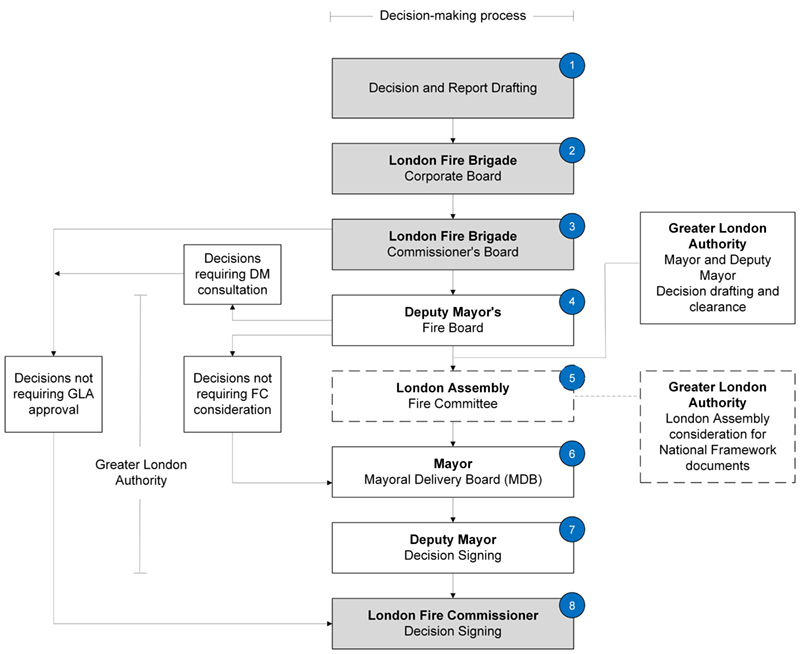
179. Steps one to three incorporate the LFC’s internal decision-making structures. Step four is required by the Deputy Mayor for Fire to ensure that only approved business proceeds to the GLA for consideration. Step five is required for documents produced by LFC, including this Statement of Assurance and similar documents that fall under the national framework; these require a report and consideration by the Fire Committee (as the proper instrument of the London Assembly). Steps six and seven are Greater London Authority (GLA) stages, required for a formal decision of the Mayor or Deputy Mayor for Fire (DMF) where the London Fire Commissioner has been required to consult or seek prior consent by the Mayor’s London Fire Commissioner Governance Direction 2018. Steps six and seven are not needed in matters that require prior consultation, as opposed to prior approval. Step eight is the final stage in the process.
180. Scrutiny of the decision-making framework is exercised through a suite of LFC Corporate (or Thematic) Boards (including an independent Audit Committee), the LFC’s Commissioner’s Board, the Deputy Mayor’s Fire Board, and the London Assembly via the Fire Committee.
181. In 2024/25, the LFC implemented revisions to its Thematic Board structure. As LFB progresses between transition states of the CRMP delivery plan and moves to a position of continuous improvement, there is increased importance on the risk and assurance function and greater reliance on the checks and balances at a strategic board level as a line of defence in the business assurance framework.
182. That responsibility resided with the Performance, Risk and Assurance Board (PRAB), however the results of an internal board effectiveness survey indicated that the wide scope and volume of activity undertaken by that Board was so great that there was insufficient time for that critical role to be undertaken effectively at meetings.
183. PRAB was therefore disbanded and replaced with two boards. One board dedicated to Portfolio, and one board dedicated to Risk and Assurance which meet on a quarterly basis. PRAB’s performance responsibilities (essentially the completion of actions/activities distributed to departments) transferred to Service Delivery Board, a move towards reflecting a business-as-usual service delivery model.
Review of effectiveness of governance arrangements
184. The LFC uses several ways to review the effectiveness of governance arrangements. One of the key assurance statements, in reviewing effectiveness, is the annual report and opinion of the external auditors. In recent years however there has been a backlog of audits across the local government sector. The Government has implemented measures to rectify the situation however it will take a number of years for a return to normal. In the meantime, the LFC’s external auditors have issued disclaimers of opinion for 2022/23 and 2023/24 and a qualification is expected for 2024/25 (subject to completion of the audit), with a view to a full audit returning in 2025/26. The external auditors also provide an annual commentary on value for money (vfm) against three specific criteria: financial sustainability; governance; and improving economy, efficiency and effectiveness. For 2023/24, the auditors concluded that there were no significant weaknesses in these areas. The vfm commentary for 2024/25 will be completed as part of the audit for that year.
185. Another significant element is the internal audit function conducted on behalf of the LFC by the Mayor’s Office for Policing and Crime (MOPAC). MOPAC is fully compliant with Public Sector Internal Audit Standards (PSIAS). Internal audit covers key governance processes, risk management and internal controls.
186. During 2024/25, Internal Audit reviewed and reported on key areas of the business. The internal auditors’ opinion for 2024/25 was that, based on the areas audited, the control framework continues to develop but is not yet fully effective in supporting the achievement of strategic objectives. There is clear evidence of increased consideration of appropriate control environments at a strategic level however, this is not currently being implemented to business-as-usual activity. Increase in second line assurance capability and ongoing development of the Enterprise Assurance Framework will help to ensure that appropriate controls are in place. The level of controls required will need to be commensurate with the risk appetite that has been adopted during the year.
187. The preparation of an Annual Governance Statement to support the Annual Statement of Accounts is a statutory requirement for local authorities. Its purpose is to demonstrate and evidence that there is a continuous review of the effectiveness of the Authority’s internal control, performance, and risk management systems.
188. The latest statement for 2024/25 highlights LFB’s progress in its transformation journey exemplified through the most recent inspection results by His Majesty’s Inspectorate of Constabulary and Fire and Rescue Services and an upward trend in performance compared to previous inspections. The Areas for Improvement (AFI) arising from that inspection have formed a plan alongside new actions arising from the Grenfell Tower Inquiry Phase two report with scrutiny of evidence to support closure of actions undertaken through internal governance boards.
189. The statement also recognises the challenging financial environment the LFB faces in 2025/26 and its impact on the programmes of transformation articulated in the CRMP. Several programmes have been paused, with some initiatives being transferred for delivery by departments. The remaining programmes have been scaled back or refocused to support improved productivity and efficiency.
190. To mitigate risks associated with a reduction in resources for project, change, and programme management, the LFC’s prioritisation framework has been applied to projects. The framework assesses project contribution to CRMP objectives, prioritising resources on high benefit/high impact projects, establishing regular health checks and integrated project assurance, assessing departmental capacity, and implementing a mandatory change management framework.
191. Furthermore, a mitigation plan has been developed which focuses on prioritising mitigations and risk management activities, ensuring that resources are allocated efficiently to maximise impact. By implementing this mitigation plan, the LFC will be able to minimise the impacts of budget constraints in the short term while continuing to make progress towards the LFC’s long-term objectives.
192. The LFC’s increasing maturity towards risk and risk management also features in the statement. The LFC has adopted a risk appetite statement, setting a ‘‘Cautious’ appetite for risk. This means that risks should have a target level of yellow (score between 4-9) and the current risk exposure should be managed to this level. Red and amber risks will be outside the LFB’s tolerable range and every effort will be made to reduce the risk exposure with a target date set for when the risk will be managed down from those risk levels.
193. The Annual Governance Statement forms part of the Statement of Accounts for 2024/25.
Transparency
194. The LFC continues to be committed to meeting the mandatory requirements for the publication of transparency data set out in the Local Government Transparency Code (DCLG, February 2015) and the Information Commissioner’s definitions document for Freedom of Information Act (FOIA) publication schemes. There is a dedicated transparency page on our external website as well as a number of data sets on the GLA London Datastore, including data for all incidents we attended and resources we mobilised to those incidents since January 2009 (updated monthly). The web mapping tool allows users to see the numbers of different types of incidents as well as attendance times for first and second fire engines down to ward level and is updated monthly. Publishing data helps us to reflect on our own performance and drives continuous improvement. Whether it is through incident response data, protection and prevention or our workforce data. The LFC commitment to transparency holds us to account and builds public trust and confidence in the communities we serve.
Enterprise Assurance Framework
195. The LFB Enterprise Assurance Framework (EAF) sets out the Brigade’s approach to identifying and mapping our key processes and controls, and understanding what assurance is in place across the ‘four lines of assurance’.
196. During 2024/25 control mapping process has continued in the first line of assurance alongside the continuation of control evaluation by the second line of assurance.
197. Further work was undertaken to begin mapping all assurance activities across the four lines of assurance, in each of the LFB departments, to better align what assurance is taking place. This will allow for future audit and assurance planning and reduce the potential risk of duplication.
Internal Audit (part of Mayor’s Office for Policing and Crime)
198. The Internal Audit function reviews our key governance processes, risk management and internal controls. During 2024/25, our Internal Auditors’ opinion was that, based on the areas audited, the LFC’s control framework is adequately designed although some controls are not operating effectively to mitigate key system risks. There is an end of year report detailing the work conducted by Internal Audit
199. An integral part of building the Brigade’s enterprise assurance framework is reducing the time to close audit and assurance actions and learn from recommendations from our independent audit providers, including MOPAC.
200. Progress on audits is provided to the Risk and Assurance Board on a quarterly basis and all audit recommendations over 90 days are highlighted for potential review.
Independent Operational Assurance Advisor (IOAA)
201. As part of our response to the recommendations of the GTI Phase One Report and HMICFRS inspection, the Brigade commissioned the services of an Independent Operational Assurance Advisor (IOAA) to carry out a programme of assurance work that reflects the risk critical improvement priorities of the Brigade.
202. The IOAA has submitted five reports in total for specific areas of assurance across LFB and raised several recommendations requiring attention. reports covered:
- Learning and Improvement
- Incident Command
- Training Assurance
- London Operations Centre
- Operational Resilience
203. All recommendations arising from these reports were reported to the Risk and Assurance Board on a quarterly basis. All recommendations arising from these reports have now been closed.
The Audit Committee
204. The Audit Committee, which comprises independent and experienced professionals appointed to serve terms of up to six years, was introduced in November 2020 to provide more robust scrutiny and assurance of the Brigade’s financial, risk and governance and other internal control arrangements.
205. The Committee adopts a thematic approach whereby time is dedicated at each of its four meetings to analyse a key corporate risk with deep dives undertaken to better understand the landscape within which it exists, whilst also retaining an overarching view of Brigade-wide matters through scrutiny of periodic integrated reports such as the quarterly Business Resilience and Key Performance Indicators (KPIs) reports, and annual reports such as the annual governance statement and statement of accounts.
206. The formal scrutiny work undertaken at committee meetings is supplemented by informal work undertaken by its committee members to better understand and acquaint themselves with the operation of the Brigade.
Risk Management
207. Risk management is an essential component of the Brigade’s governance framework and supports the achievement of LFB’s strategic objectives. Effective risk management increases the probability of successful outcomes, whilst protecting the reputation and trust in the Brigade by our communities. Put simply, the Assessment of Risk (referenced earlier in this statement) assesses risks in the community, whereas the corporate risk framework assesses internal risks to the Brigade.
208. The latest iteration of the Brigade’s internal risk management framework has been in operation since May 2021 and enables the organisation to identify and manage significant corporate risks. The framework is applied LFB-wide across departments where risks are evaluated for their likelihood and impact. This provides a risk score and places the risk in the framework at an appropriate level (red, amber, yellow or green) whereby they can be monitored, managed, and scrutinised effectively. Risks, and risk management action, are reviewed on a quarterly basis (with more frequent check-ins on red risks) at risk review meetings and/or local management meetings. A quarterly risk overview report is presented to Risk and Assurance Board to scrutinise the risk management framework as a whole, and where changes to red risks are considered. The Business Resilience departmental plan sets out the steps we are taking to continuously improve our approach to risk management.
209. As mentioned in the previous year’s statement, the increasing levels of maturity with regards to risk management and ownership have enabled a risk appetite approach to be developed. While there is always more to do in this respect, especially embedding risk management throughout all levels of the Brigade, the Head of Risk determined that the Brigade was mature enough to apply a risk appetite methodology to further enhance risk management. Having a defined risk appetite forms part of good risk management practice and is recommended by the Institute of Risk Management (IRM) as well as many other risk professionals.
210. The outcome of the work to develop a risk appetite during 2024/25 has led to the LFC adopting a risk appetite statement, setting a ‘‘Cautious’ appetite for risk. This means that risks should have a target level of yellow (score between 4-9) and the current risk exposure should be managed to this level. Red and amber risks will be outside the LFB’s tolerable range and every effort will be made to reduce the risk exposure with a target date set for when the risk will be managed down from those risk levels.
211. Work will continue throughout 2025/26 to further review, refine and apply risk appetite in managing the Brigade’s corporate risks.
Cyber Security
212. Arising from the Government Cyber Security Strategy 2022 – 2030, a Cyber Assessment Framework (CAF) for Fire and Rescue Services strengthens the resilience of the sector to cyber-attacks. The CAF entered the delivery phase during 2024/25. The CAF now forms the focal point of LFB’s adherence to standards for cyber security and resilience. LFB’s information security policy is also aligned to ISO 27001.
213. Processes for managing supply chain security have been improved, including the introduction of a platform for managing supply chain risk management.
214. Preparedness for cyber incidents has additionally been improved through updating response plans and exercising.
215. IT health checks are conducted annually with appropriate priority given to remediation of vulnerabilities reported.
216. A positive cyber security culture is fostered with NCSC accredited cyber security and data protection awareness training delivered to staff which needs to be completed annually by all staff.
Future Improvements
217. LFB is working towards Cyber Essentials Plus certification. A working group meets monthly to review and monitor progress.
218. A contract has been entered into for cyber incident response retained services with a NCSC-assured provider to strengthen capability to respond to a cyber incident.
Business Continuity
219. The LFB Business Continuity Management Programme is aligned to leading industry standards ISO 22301 and the Business Continuity Institute (BCI) Good Practice Guidelines.
220. Business Continuity works with all departments to ensure that continuity plans are in place for critical processes, which remain under regular review. A full review of departmental Business Impact Analysis and Business Continuity Plans was started across the Brigade, working with key heads of service to ensure the plans are up to date and fit for purpose.
221. During 2024-25 the Business Continuity Team launched a new set of templates, guidance, and training materials to drive improvements and promote awareness of business continuity within the organisation.
222. There was a specific focus on ICT-related business disruptions and ensuring that dependencies on systems and data are properly considered within business continuity plans, as the cyber threat continues to evolve. This culminated in a simulated cyber-attack exercise for senior leaders by March 2025.
223. The exercise was well received by the participants and highlighted key areas to be looked at in greater details. The Chief Information Security Officer (CISO) has taken away the learning from this to be developed further with the ICT team and BC team.
Future Improvements
224. A main focus for 2025-26 will be ensuring that business continuity plans continue to adapt to new and emerging threats. This will include working with colleagues in Property & TSS and Fire Stations to consider the potential business continuity impacts of carbon net zero programmes on our estate and fleet and preparing for station-level disruptions caused by flooding.
Financial Assurance
Statement of Accounts
225. All local authority accounts are required to adopt “proper accounting practice” based on either statutory requirements or the Code of Practice on Local Authority Accounting in the UK (the Code) as published by the Chartered Institute of Public Finance and Accountancy (CIPFA). These specify the principles and “present a true and fair view”.
226. The LFB Director for Corporate Services approved the draft Statement of Accounts for the financial year 2024/25 on 23 June 2025. This was then published as a draft and submitted for external audit.
227. An independent audit of the accounts is undertaken by an external audit provider. For the year 2024/25, this work is to be undertaken by Ernst and Young LLP.
228. The external auditor undertakes a review of the accounts and forms an overall opinion, which is published as part of the audited Statement of Accounts.
229. A copy of the draft Statement of Accounts for 2024/25 can be found in the Publication Scheme.
Efficiency Planning
230. In March 2016, the Secretary of State for Communities and Local Government invited local authorities to publish locally owned and locally driven four-year efficiency plans. A separate efficiency plan was prepared to meet this requirement for the first four years. Subsequently the fire and rescue national framework set out the documents each Fire and Rescue Service (FRS) is required to produce, which include an annual efficiency plan, medium term financial strategy and a reserves strategy.
231. To meet this requirement a Medium-Term Financial Plan, Reserves Strategy and Efficiency Plan were incorporated into and approved as part of the LFC’s Budget Submission for 2025/26 to the Mayor (LFC–24-108), for consultation with the Fire Committee. This was then updated and approved as the LFC Final Budget 2025/26 (LFC-25-026).
Inspection, Intervention and Accountability
His Majesty’s Inspectorate of Constabulary and Fire and Rescue Services
232. London Fire Brigade’s third full inspection by His Majesty’s Inspectorate of Constabulary and Fire and Rescue Services (HMICFRS) took place in summer 2024 and HMCIFRS published its report in November 2024.
233. The report demonstrates a clear assessment of positive change across nearly all areas of the Brigade and improvements in 10 out of 11 areas in inspection. In addition, they highlighted eight examples of promising practice and three examples of innovative practice.
234. Since the previous inspection, a great deal of change has taken place and has been underpinned by millions of pounds of investment provided by the Mayor of London. This has resulted in firefighters and Control officers being better prepared, trained and equipped to deal with fires across London.
235. The Inspectorate has acknowledged the strides taken to improve the service LFB provides to London, as well as changed ways of working and ongoing work to transform culture across the organisation. This has included our improved understanding of risk and other emergencies through our CRMP.
236. However, there is no room for complacency and LFB will seek to build on this positive outcome. The HMICFRS highlighted 11 specific Areas for Improvement within the latest inspection report. This includes prioritising the risk-based inspection programme, recruiting a more diverse workforce, continuing to build confidence in processes for dealing with poor behaviour, and creating a process for identifying talent and future leaders within the Brigade.
237. The Inspectorate reached their conclusions based on the thousands of interactions they had with LFB staff. This included visits to stations, focus groups and staff surveys.
Grenfell Tower Inquiry
238. The Grenfell Tower Inquiry (GTI) published its Phase two report and recommendations on 4 September 2024. One recommendation was directed specially to the LFB and five were directed to all Fire and Rescue Services, including LFB. Three recommendations were also directed to HMICFRS in regard to assurance around LFB improvements made to address the Inquiry’s Phase 1 recommendations in October 2019.
239. The Phase two recommendations differ from those included in the Phase one report in that they are less specific in nature and lend themselves less to the formation of a separate action plan. In addition to this, LFB is already working on those areas identified by the Inquiry to deliver improvements through existing programmes of work or business as usual continuous improvement activities. Therefore, LFB has concluded it is more effective to continue to deliver the relevant improvements through these existing mechanisms rather than through the creation of an additional action plan, which sits outside of its now established portfolio approach.
240. In directing three recommendations to HMICFRS, the Inquiry has recognised that significant improvement has already been made by LFB in the areas of Control, Incident Command training and Operational Planning, and is therefore providing an opportunity for HMICFRS to assure the outcomes are delivering the intended benefits, much of which was covered in the Brigade’s 2024 full inspection. Nonetheless, LFB is on a journey of continuous improvement and, therefore, further work in these areas remains high on its list of priorities.
241. HMICFRS published a statement on 12 February 2025 stating ‘We welcome the findings and recommendations in the Inquiry’s Phase two report. We accept the three recommendations directed to us, which we have already addressed through our recent inspection of London Fire Brigade. The report for this inspection was published on 29 November 2024.’
242. The inspection report, published on 29 November 2024, stated that HMICFRS had found significant improvements in the Brigade’s performance since its previous full inspection. The report highlighted that the Brigade had improved across ten of the 11 measures used in the inspection, with six areas rated as ‘outstanding’ or ‘good’. This is in sharp contrast to its previous inspection in 2022 demonstrated that improvement was required in all 11 areas.
Culture Review
243. In 2022 the brigade launched three leadership programmes which represented the largest leadership training programme in the Brigade’s history. Following the Culture Review and HMICFRS reports, it was appropriate to consider how LFB training, and learning and development provision could be improved. The current redesign of the programme includes the adoption of the NFCC Supervisory Leadership Development Programme and Middle Leadership Development Programme. Robust evaluation processes have been introduced for all current leadership training courses.
244. In June 2023 LFB launched appraisal conversations. As part of this process staff are asked to discuss career aspirations with their line manager. This is the first step in staff understanding the progression paths open to them and the development required to progress and supports the work officers are about to commence on talent management across all staff groups. LFB values have been incorporated into the appraisals and work is underway to expand the process so more detailed analysis of development needs and potential pathways can be assessed.
245. Since the publication of the Culture Review over 1,000 leaders have attended a course that helps them recognise and manage stress, anxiety and depression in themselves and their staff. Our Mental Health First Aider scheme continues to grow with over 450 staff now trained to provide emotional support and signposting for colleagues. The Samaritans have been supporting LFB in reviewing our policies and procedures in relation to suicide. The review was supported by a Steering Group comprising of representatives from the Culture Transformation programme, Trade Unions, Equality Support Groups, Positive Improvement Team, Fire Fighters Charity, Wellbeing team and Counselling and Trauma Service. A suicide postvention toolkit is being developed to ensure a consistent and effective response which supports staff involved and affected. This will be supported by learning and development for all staff and specific training for those who perform key roles.
246. In response to the independent review of People Services, the brigade has brought in additional staff to support the changes required and to modernise the current HR operating model. Since May 2023 work has been ongoing to align the activities in People Services to our strategic priorities. This has been the focus of the new director for People who joined the organisation in January 2025 including a restructuring of the HR functions which is being carried out in two phases.
247. LFB has reviewed all our HR policies to ensure they are current, consistent, clear, and simple. This has resulted in the number of HR policies being reduced from 114 to 63, with the revised policies using simple language and guidance notes to ensure accessibility for staff. The brigade has developed a new People Strategy. In order to improve the service provided to staff Help Desk staff have received training and new Frequently Asked Questions have been developed.
Future Improvements
248. Training for managers will be rolled out by a restructured HR Business Partnering team. To support the transformation and professionalisation of the directorate, officers are exploring accredited Chartered Institute of Personnel and Development (CIPD) training.
Assurance Declaration
This statement functions as the LFC’s Statement of Assurance under the Fire and Rescue Service National Framework. Officers are satisfied that the elements of the LFC’s system of internal control meets the requirements of the National Framework. Where recommendations have been made about the LFC’s financial and governance and operational assurance arrangements through internal or external assessment, appropriate action plans have been put in place to improve and address these, to make sure that they are adequate and operating effectively.
Jonathan Smith, London Fire Commissioner