- London Fire Brigade is urging caution ahead of the clocks going forward this weekend as new data reveals fire calls rise by 25 per cent in April compared to March
- The number of fires attended between 5pm and 6pm increases by around 10 per cent on average when the clocks go forward compared to the same period during the winter
- Early evening (5pm–8pm) sees over three times the number of fires compared to the quietest period (4am-7am)
- The main causes of fire during the peak period (5pm-8pm) include cooking (4,430 fires) and electrical faults (2,100 fires)
- London Fire Brigade asks households to check smoke alarms and complete their free Home Fire Safety Checker as routines change with lighter evenings.
As Londoners prepare for longer, lighter evenings with the clocks going forward this weekend, London Fire Brigade is warning that the seasonal change is linked to a significant increase in fires.
New analysis of emergency calls to fires over the past few years shows a consistent rise in calls immediately after the clocks go forward from March to April. During this period, calls to the Brigade’s Control Room reporting fires increased from 6,432 in March to 7,994 in April, an increase of almost 25 per cent.
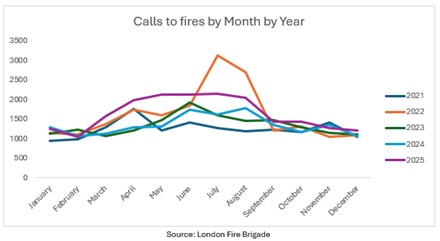
Data on the number of fires between 2016 and 2025 also show a consistent pattern, with the number of fires attended between 5pm and 6pm increasing by around 10 per cent on average when the clocks go forward. Firefighters attended 83,628 incidents during British Summer Time (BST), compared with 54,894 in the darker months, with activity peaking in June, July and August. This equates to a summer monthly average of approximately 11,947 fires and a winter average of around 10,979 fires, an increase of just under 10 per cent.
The data also confirms that early evening remains the highest-risk time of day, with incidents between 5pm and 8pm more than three times higher than during the quietest hours between 4am and 7am. Over the past 10 years, firefighters attended almost 205,000 incidents between the hours of 5pm to 8pm, compared to just under 62,000 incidents between 4am and 7am.
The Brigade believes the spike reflects busy evening routines, when households are cooking dinner, charging devices, using electrical appliances and relaxing at home after work or school. These figures tend to rise even further during the warmer months, when lighter evenings often bring changes to daily habits and more time spent socialising or cooking at home. Cooking remains the leading cause of fires during the peak 5pm–8pm period, accounting for 4,430 incidents between 2016 and 2025, with electrical faults (2,100 fires) and smoking (1,428) following behind.
The Brigade is encouraging residents to take a few minutes to complete its online Home Fire Safety Checker to help reduce the risk of fire in homes across the capital as we approach summer. The quick digital tool identifies potential hazards and provides tailored safety advice. Residents who may be at higher risk can also be referred for a free in-person visit from their local fire station.
Assistant Commissioner for Prevention and Protection Pam Oparaocha said: “Our data shows a clear pattern that as soon as the clocks go forward, we see a noticeable increase in the number of fires and emergency calls.
“With lighter evenings comes a change in routine, with households more likely to be less focused on what is going on in the house as they seek to enjoy the brighter hours and that can mean more opportunities for fires to start.
“Taking a few quick steps can make a real difference when it comes to protecting your home. Our free online Home Fire Safety Checker only takes a few minutes to complete and provides personalised advice for your home and lifestyle. It’s one of the easiest ways Londoners can reduce their risk of fire.”
As London springs forward, firefighters say taking just a few minutes to review fire safety could make all the difference in keeping homes and families safe. Find more home safety advice on the London Fire Brigade website.
Check your home's safe using our simple tool
It only takes two minutes to check your home and get tailored advice for your family.
Notes to editors
1. Number of calls to fires
| Month | 2021 | 2022 | 2023 | 2024 | 2025 | Grand Total |
| January | 945 | 1154 | 1122 | 1288 | 1261 | 5770 |
| February | 992 | 1100 | 1229 | 1061 | 1053 | 5435 |
| March | 1287 | 1370 | 1074 | 1131 | 1570 | 6432 |
| April | 1771 | 1740 | 1218 | 1283 | 1982 | 7994 |
| May | 1212 | 1593 | 1470 | 1307 | 2120 | 7702 |
| June | 1417 | 1851 | 1935 | 1742 | 2119 | 9064 |
| July | 1265 | 3138 | 1602 | 1626 | 2140 | 9771 |
| August | 1190 | 2695 | 1458 | 1781 | 2054 | 9178 |
| September | 1232 | 1207 | 1466 | 1348 | 1445 | 6698 |
| October | 1161 | 1309 | 1285 | 1169 | 1435 | 6359 |
| November | 1407 | 1057 | 1153 | 1348 | 1266 | 6231 |
| December | 1050 | 1084 | 1108 | 1073 | 1203 | 5518 |
| Grand Total | 14929 | 19298 | 16120 | 16157 | 19648 | 86152 |
2. Sum of total fires between 5pm-6pm (2016-2025)
| Month | After clock change | Before clock change | Grand Total |
| January | 0 | 10634 | 10634 |
| February | 0 | 9883 | 9883 |
| March | 0 | 11158 | 11158 |
| April | 10492 | 0 | 10492 |
| May | 11507 | 0 | 11507 |
| June | 12013 | 0 | 12013 |
| July | 13210 | 0 | 13210 |
| August | 12190 | 0 | 12190 |
| September | 11894 | 0 | 11894 |
| October | 12322 | 0 | 12322 |
| November | 0 | 11837 | 11837 |
| December | 0 | 11382 | 11382 |
| Grand Total | 83628 | 54894 | 138522 |
3. The time-of-day London Fire Brigade attends the most incidents in the last 10 years is 5pm to 8pm. During this time, firefighters attended:
- 67,420 incidents at 5pm
- 68,912 incidents at 6pm
- 68,164 incidents at 7pm
4. The time-of-day London Fire Brigade attends the least incidents in the last 10 years is 4am to 7am. During this time, firefighters attended:
- 20,385 incidents at 4am
- 19,309 incidents at 5am
- 22,092 incidents at 6am
5. Top causes of fires between 5pm-7pm (2016-2025)
| Cause | Total Incidents |
| Cooking | 4430 |
| Deliberate / intentional fires (including bonfires spreading out of control) | 3091 |
| Electrical faults | 2100 |
| Combustible articles too close to a heat source (e.g. a heater or fireplace) | 1751 |
| Fault with equipment or appliances | 1987 |
| Unsafe disposal of smoking materials/ lighters | 1428 |